
Autonomous Sales Systems for 24/7 SaaS Selling
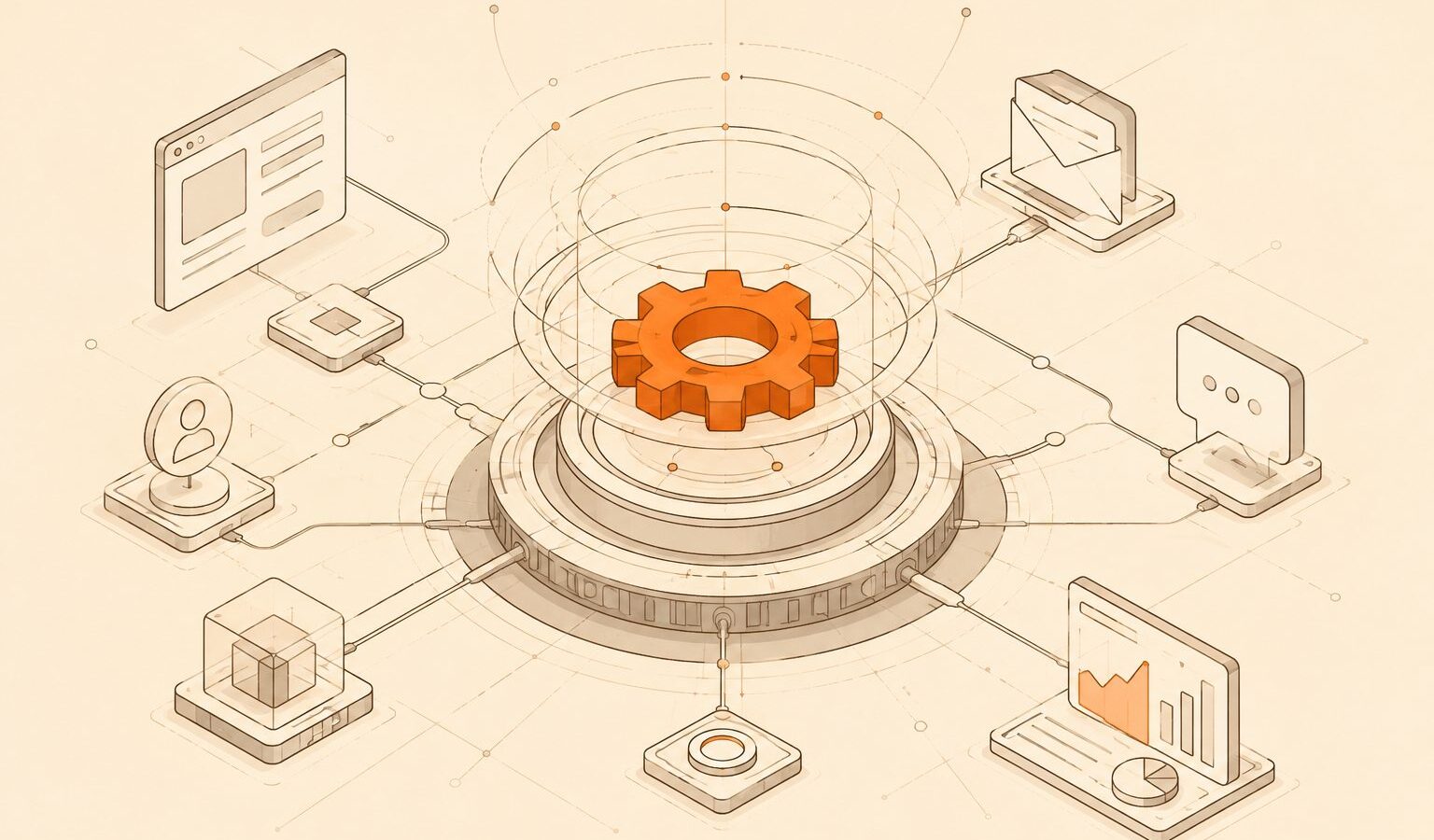
Autonomous sales systems are AI-enabled sales platforms that can answer buyer questions, qualify leads, route accounts, trigger follow-ups, and book meetings without waiting for a human rep. For SaaS teams, the real goal is not replacing sales. It is protecting every high-intent moment: nights, weekends, holidays, global time zones.
The best system behaves like a controlled sales layer between your website, CRM, calendar, sales playbook, and human team. Simple conversations move forward automatically. Risky, strategic, or high-value moments escalate to people.

What is an autonomous sales system?
An autonomous sales system is software that performs sales actions with limited human input: interpreting buyer intent, asking qualification questions, updating CRM fields, following a playbook, and taking next steps such as booking a meeting or routing a lead.
Unlike a chatbot, it handles more than FAQs. Unlike basic sales automation, it does more than fixed “if this, then that” rules. It combines conversation, decision logic, workflow execution, and governance.
A practical SaaS setup usually includes:
- Conversational AI for website, email, chat, SMS, or voice interactions.
- Lead qualification automation based on ICP, firmographics, use case, urgency, and buying authority.
- CRM and calendar actions such as creating records, enriching accounts, assigning owners, and booking meetings.
- Sales playbook automation for objection handling, pricing boundaries, competitor questions, and escalation rules.
- Audit controls so revenue leaders can inspect what the agent said, why it acted, and when humans intervened.
For a deeper comparison of agent types, see toppp.ai’s guide to AI sales agents and what SaaS buyers should compare before buying.
Why 24/7 coverage matters more than “more automation”
The biggest value of 24/7 sales automation is speed-to-lead. If a buyer asks for pricing at 11:42 p.m., the system must qualify intent, answer approved questions, and offer a next step before the buyer compares alternatives.
InsideSales reported that conversion rates were more than 8x higher when contact was attempted in the first five minutes rather than later, based on their lead response management research. The exact lift varies by market, but the operating principle is stable: buyer intent decays quickly.
For SaaS, the after-hours gap is especially costly because buyers often research software outside meeting-heavy work blocks. A 24/7 system should be measured against three outcomes:
- Did it respond while intent was still active?
- Did it collect enough context for the next human or automated step?
- Did it avoid overpromising, hallucinating, or mishandling sensitive data?
That last point is why “always on” must be paired with guardrails.
The Night Coverage Score: a buyer framework for autonomous selling
The Night Coverage Score is an evaluation framework for SaaS buyers comparing autonomous sales systems. It measures whether the system can safely convert after-hours demand, not just whether it has AI features.
Score each category from 0 to 5, then total the result out of 25.
| Category | What to inspect | Strong signal |
|---|---|---|
| Response continuity | Can the system handle chat, forms, email, and calendar requests after hours? | Replies in seconds and preserves context across channels |
| Qualification depth | Can it qualify by ICP, pain, urgency, budget range, role, and product fit? | Captures structured CRM-ready fields, not just free text |
| Playbook control | Can sales leaders define allowed claims, pricing boundaries, objection handling, and handoff rules? | Versioned playbooks with approval workflows |
| Escalation safety | Does it know when not to act autonomously? | Routes enterprise, legal, security, or discount requests to humans |
| Revenue attribution | Can it show pipeline influenced, meetings booked, no-shows, and disqualified leads? | Dashboards tie conversations to CRM opportunities |
A score below 15 means the tool is probably an AI assistant, not a full autonomous sales layer. A score of 18-21 is workable for inbound qualification. Above 22 suggests the system may support broader motions such as outbound follow-up, expansion conversations, and partner-led routing.
Teams evaluating overnight coverage can also compare their requirements against toppp.ai’s guide to overnight sales automation tools for faster replies.
Which sales tasks should be autonomous, assisted, or human-owned?
Not every sales task should be autonomous. The best implementations separate low-risk, repeatable actions from high-risk, judgment-heavy decisions.
| Sales activity | Best ownership | Why |
|---|---|---|
| Greeting website visitors | Autonomous | Low risk and time-sensitive |
| Asking qualification questions | Autonomous | Structured and repeatable |
| Answering approved product FAQs | Autonomous | Works well with grounded knowledge |
| Booking standard demos | Autonomous | Clear next step with measurable value |
| Routing by segment or territory | Autonomous with rules | Requires clean CRM logic |
| Discussing custom enterprise pricing | Human-assisted | High commercial risk |
| Negotiating legal terms | Human-owned | Requires judgment and accountability |
| Handling angry or confused buyers | Human-assisted | Brand and trust risk |
| Creating final proposals | Human-owned or approved | Requires accuracy and commercial review |
This division prevents a common failure: letting an agent appear powerful in demos but unsafe in real buying conversations. A good autonomous SDR should be confident in narrow lanes and conservative outside them.
For a related routing model, toppp.ai’s B2B sales qualification automation framework explains how to structure qualification logic before buying software.
How to evaluate vendors without falling for “AI rep” hype
A strong vendor evaluation starts with proof of behavior, not feature labels. Ask vendors to demonstrate the system on your real sales scenarios, using your ICP, competitors, pricing constraints, and routing rules.
Use these questions in demos:
-
What actions can the agent take without approval?
Separate “can answer” from “can update CRM,” “can email,” “can call,” and “can book.” -
What knowledge is it grounded on?
Look for controlled sources: approved product docs, sales playbooks, CRM records, website content. -
How does it fail safely?
The system should escalate when confidence is low, when a buyer asks legal or security questions, or when the request exceeds approved policy. -
Can managers inspect decisions?
Logs should show prompts, knowledge used, conversation outcomes, CRM changes, and handoff reasons. -
How is performance measured?
Useful metrics include median response time, qualified meeting rate, handoff accuracy, show rate, pipeline accepted by sales, and conversation containment rate.
The FTC has warned businesses to avoid unsupported AI claims in its guidance to keep AI claims in check. For buyers, that means vendor promises should be tied to observable workflows, test data, and contractual responsibilities.

What integrations matter for a 24/7 autonomous sales stack?
The required integrations depend on your sales motion, but five systems usually determine whether autonomous sales systems create clean pipeline or operational noise.
First, the CRM must remain the source of truth. If the agent creates duplicate contacts, overwrites owner fields, or fails to log disqualification reasons, sales trust will collapse.
Second, calendar integration must respect availability, round-robin rules, territory logic, and meeting types. Booking a demo only matters if the right rep gets the right buyer.
Third, knowledge sources must be controlled. Product pages, help docs, security documents, pricing rules, and competitor guidance should be versioned and reviewable.
Fourth, messaging channels should reflect buyer behavior. SaaS companies may start with website chat and email, then add voice, SMS, or WhatsApp where appropriate.
Fifth, analytics must connect conversations to revenue outcomes. A dashboard showing “1,000 conversations handled” is weaker than one showing qualified meetings, accepted opportunities, expansion leads, and avoided rep workload.
For broader stack planning, toppp.ai’s guide to virtual sales team software covers how AI agents, automation, and human reps fit together.
Governance is the difference between automation and revenue infrastructure
Governance turns an autonomous sales tool into dependable revenue infrastructure. Without it, the same system that books meetings quickly can also invent discounts, mishandle private data, or route strategic accounts incorrectly.
A buyer-ready governance checklist should include:
- Approved knowledge only: The system should answer from sanctioned content, not open-ended guessing.
- Human escalation rules: Enterprise, legal, procurement, security, and angry-customer paths need clear handoff.
- Role-based permissions: Not every admin should edit pricing language or CRM-write permissions.
- Conversation logs: Managers need searchable transcripts and decision trails.
- Testing before launch: Run red-team scenarios for competitors, discounts, regulated claims, and unknown answers.
- Ongoing monitoring: Track drift in answer quality, qualification accuracy, and escalation rates.
The NIST AI Risk Management Framework describes trustworthy AI in terms such as validity, reliability, safety, security, accountability, transparency, explainability, privacy, and fairness. SaaS buyers do not need to turn vendor selection into a compliance audit, but those concepts help when asking whether an autonomous sales agent can be trusted with real buyers.
How to pilot an autonomous sales system in 30 days
A 30-day pilot should prove one narrow revenue outcome before expanding. The best first use case is usually inbound after-hours qualification and booking: clear timestamps, measurable intent, direct CRM impact.
Use this sequence:
-
Define one motion.
Example: website demo requests from companies with 50-1,000 employees in North America. -
Write the allowed playbook.
Include qualification questions, product claims, pricing boundaries, disqualification rules, and escalation triggers. -
Connect only necessary systems.
Start with website chat or form capture, CRM, calendar, and approved knowledge sources. -
Run shadow mode.
Let the system draft responses and recommended actions before it acts independently. -
Launch controlled autonomy.
Allow booking, routing, and CRM logging for qualified leads while keeping sensitive cases human-owned. -
Review weekly.
Track response time, qualified meeting rate, false positives, false negatives, escalations, and sales-accepted pipeline.
A good pilot ends with a go/no-go decision. If the agent improves speed and qualification quality without creating cleanup work, expand to more channels. If it books low-fit meetings or confuses buyers, fix the playbook before adding volume.
What ROI should SaaS buyers expect?
ROI should be modeled from recovered intent, rep capacity, and pipeline quality. Avoid vendor calculators that assume every automated conversation is incremental revenue.
A simple model:
Monthly value = recovered qualified meetings x show rate x opportunity rate x average pipeline value
Then subtract software cost, implementation time, monitoring time, and any added sales cleanup.
For example, if after-hours automation recovers 20 qualified meetings per month, 70% show, 40% become opportunities, and each opportunity averages $12,000 in pipeline, the gross influenced pipeline is $67,200. That does not mean $67,200 in revenue. It means the system created measurable pipeline for sales to work.
The strongest ROI usually appears when a company already has buyer intent but loses momentum through slow response, inconsistent qualification, or poor routing. If traffic quality is weak, autonomous selling will expose that weakness rather than solve it.
For a broader ROI lens, see toppp.ai’s AI sales agents with the highest ROI evaluation framework.

Common mistakes when buying autonomous sales systems
The most common mistake is buying for autonomy level instead of revenue fit. A system that can “do everything” may be worse than one that does one motion safely and measurably.
Avoid these traps:
- Automating before cleaning the playbook. If reps disagree on qualification, the agent will amplify inconsistency.
- Ignoring CRM hygiene. Bad routing rules create bad automation.
- Letting the agent answer unsupported pricing questions. Buyers remember wrong commercial claims.
- Measuring containment only. A contained conversation is not always a successful sales outcome.
- Skipping human review. Sales managers should inspect early conversations weekly.
- Launching across too many channels. Start where intent is highest and governance is easiest.
A useful rule: give the system autonomy only where you can define success, inspect behavior, and reverse mistakes.
Frequently asked questions
Are autonomous sales systems the same as AI sales agents?
Autonomous sales systems are broader than AI sales agents. An AI sales agent is often the conversational worker, while the system includes CRM workflows, routing logic, calendars, analytics, permissions, and governance controls.
Can a 24/7 sales system close deals without humans?
Sometimes, for simple transactional products. In SaaS, most systems are better used to qualify, educate, route, and book meetings. Human reps should still own complex pricing, procurement, legal review, and strategic negotiation.
What is the first use case to automate?
The best first use case is usually inbound demo-request qualification after hours. It is measurable, high-intent, and easy to compare against baseline response time, meeting quality, and sales acceptance.
How much autonomy is safe for enterprise SaaS?
Enterprise SaaS teams should start with controlled autonomy: answer approved questions, collect qualification data, book meetings, and escalate legal, security, procurement, custom pricing, or strategic account issues.
What metrics prove the system is working?
Track median response time, qualified meeting rate, show rate, sales-accepted opportunity rate, escalation accuracy, disqualification quality, CRM cleanliness, and pipeline influenced. Conversation volume alone is not enough.
Final buyer takeaway
Autonomous sales systems are most valuable when they protect live buyer intent and make the next sales step easier. The winning system is not the one with the boldest “AI rep” claim. It is the one that responds instantly, qualifies accurately, acts inside approved boundaries, and hands off cleanly when human judgment matters.
For SaaS buyers, the practical path is simple: score your night coverage, pilot one high-intent motion, inspect real conversations, and expand only after the system proves it can create trusted pipeline around the clock.
Keep reading

Red Flags in SaaS Vendor Agreements: A Buyer’s Review Checklist
Spot red flags in SaaS vendor agreements before signing, from renewal traps and price increases to data rights, liability gaps, and exit costs.

SaaS MSA Negotiation Checklist for Buyers
Use this SaaS MSA negotiation checklist for buyers to review pricing, data, SLAs, liability, indemnity, renewal, and exit terms before signing.

SaaS vendor IP indemnification scope checklist: Buyer review guide
Use this SaaS vendor IP indemnification scope checklist to test covered claims, exclusions, defense rights, remedies, caps, and third-party risk before signing.