
Enterprise AI Tool Usage Audit Log Requirements
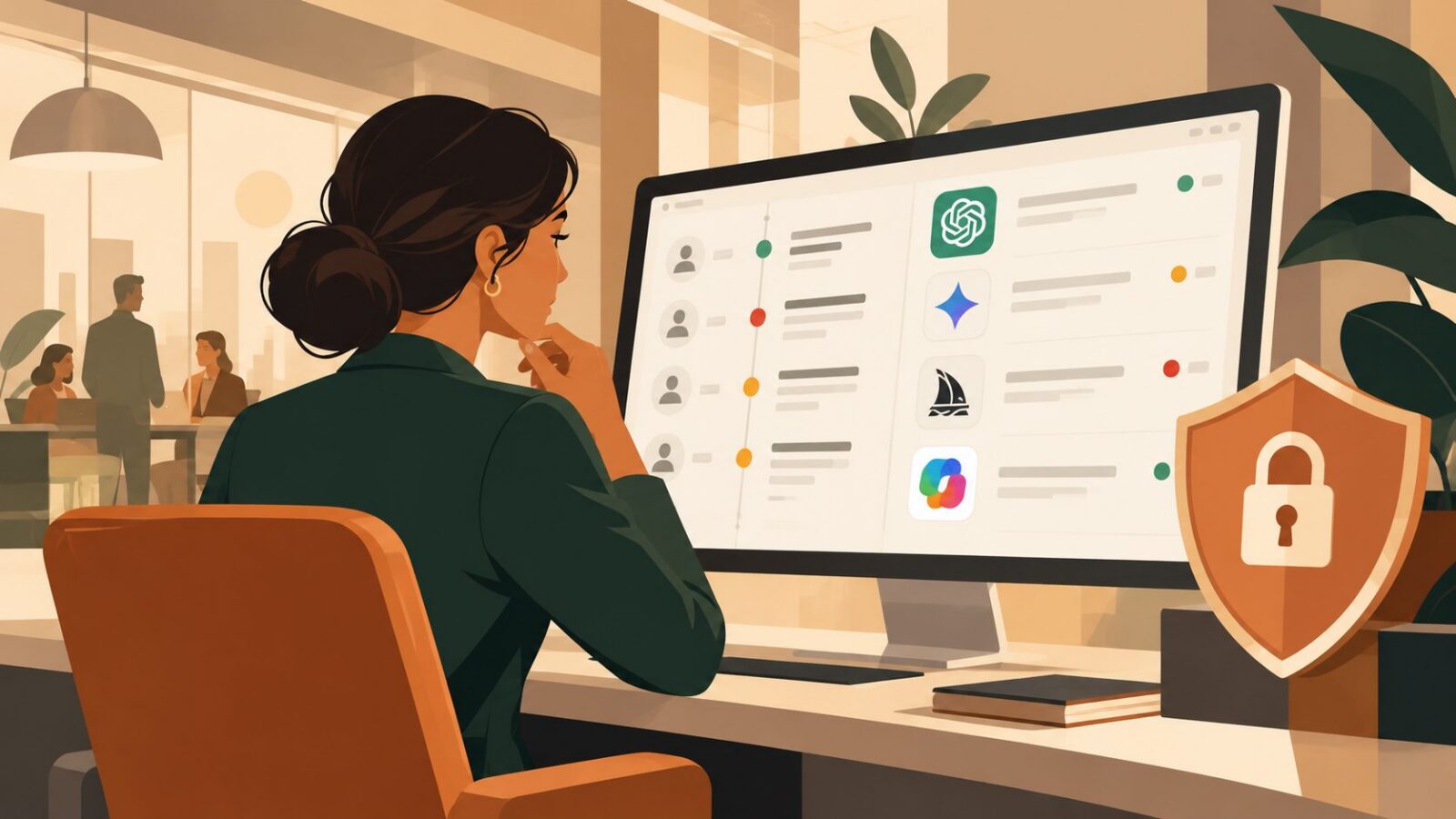
Enterprise AI tool usage audit log requirements define the evidence a vendor must create, protect, expose, and retain when employees or software agents use an AI service. A usable record should connect identity, time, tool, data movement, policy decision, model version, output, and resulting action—not merely show that a login occurred.
For procurement and compliance teams, the practical question is not “Does the vendor have audit logs?” It is: Can the organization reconstruct a material AI interaction without relying on screenshots, employee memory, or the vendor’s support team?

What should an enterprise AI audit log capture?
An enterprise AI audit log should capture enough context to reconstruct who used which AI capability, what data or tools were involved, what controls applied, and what happened afterward. NIST guidance emphasizes system logs, explanations, monitoring, and risk tracking as part of trustworthy AI operations. (airc.nist.gov)
At minimum, require these event categories:
| Category | Minimum fields to request |
|---|---|
| Identity | User ID, service account, agent ID, department, tenant, and authentication method |
| Timing | Event timestamp in UTC, session ID, request ID, start and completion time |
| AI service | Product, workspace, model, model version, deployment region, and configuration |
| Input | Prompt or request content, sensitivity label, file references, and data classification |
| Retrieval and tools | Knowledge sources, connectors, APIs, external URLs, tool calls, and handoffs |
| Controls | Policy evaluated, rule version, allow/block outcome, redaction, approval, or escalation |
| Output | Response, classification, confidence score where available, and output filtering result |
| Human action | Reviewer identity, approval or rejection, override, edit, and final business decision |
| Result | Success, failure, error code, downstream change, transaction ID, or action status |
The important distinction is between activity logs and decision evidence. An activity log may say that a user accessed an AI tool. Decision evidence shows what the tool received, which model and policy were used, whether data left the approved boundary, and whether a human accepted the result.
Which AI usage events should the vendor log?
The vendor should log more than prompts and responses. It should record the complete event chain, including administrative changes and unsuccessful attempts.
User and access events
Require records for:
- Login, logout, token creation, and API key use
- SSO, MFA, role, group, and privilege changes
- New workspace, agent, connector, or integration creation
- Permission grants, revocations, and failed authorization attempts
- Administrative exports, deletions, and retention-policy changes
These records help identify shadow AI, compromised credentials, unusual access, and insider activity. AI security guidance commonly treats tool calls, handoffs, policy enforcement, errors, and human intervention as important audit events—not optional telemetry. (techtarget.com)
Prompt, output, and data-flow events
The contract should distinguish between:
- Full-content logging, where prompts, attachments, and outputs are retained.
- Redacted logging, where sensitive values are masked before storage.
- Metadata logging, where only identifiers, hashes, classifications, and event outcomes are preserved.
Do not accept “we log prompts” as a complete answer. Ask whether the log records attachments, retrieved documents, data connectors, tool parameters, and downstream actions. For agentic workflows, a single user prompt may cause multiple API calls or changes in another system. Each consequential step needs its own event ID and parent transaction ID.
What are the security and privacy requirements?
AI audit logs can become a second sensitive data store. The RFP should therefore require controls for both evidence integrity and data minimization.
Tamper resistance
Specify that logs must be:
- Append-only or otherwise tamper-evident
- Protected from alteration by ordinary administrators
- Time-synchronized and traceable to a reliable clock
- Exportable with integrity metadata, such as hashes or signatures
- Covered by incident response and backup procedures
A vendor should be able to explain how it detects deletion, modification, clock drift, incomplete ingestion, and gaps caused by an outage. A clean report is not meaningful if the system cannot distinguish “no activity” from “logging was unavailable.”
Access control and separation of duties
Require role-based access to logs, least-privilege administration, and separate permissions for:
- Configuring retention
- Viewing sensitive event content
- Exporting records
- Deleting records after an approved retention period
- Reviewing or investigating incidents
The organization should also ask whether vendor support personnel can view prompts or outputs, under what approval process, and whether those accesses appear in the customer’s audit record.
Privacy-preserving evidence
Full prompt and output retention may conflict with privacy, confidentiality, or legal hold requirements. A practical control is to define evidence tiers:
- Tier 1: searchable metadata retained broadly
- Tier 2: redacted content retained for security and compliance investigations
- Tier 3: full content retained only for approved use cases, with restricted access
This tiered model is more workable than forcing every AI interaction into permanent full-content storage.

How long should enterprise AI logs be retained?
There is no universal retention period for every AI interaction. The contract should instead define retention by risk, record type, and legal obligation.
A procurement schedule can separate:
- Security and access events
- Policy decisions and blocked requests
- Model and prompt configuration changes
- High-impact decision records
- Incident and investigation evidence
- Billing, usage, and consumption records
For each category, specify the minimum period, deletion method, legal-hold process, export format, and restoration objective. Microsoft’s agent governance toolkit, for example, treats audit logs, policy decisions, identity records, and incident reports as separate governance artifacts with defined retention treatment. (microsoft.github.io)
The stronger requirement is not simply “retain logs for three years.” It is:
The vendor must preserve records for the contracted period, suspend deletion when notified of a legal hold or investigation, and provide a complete export covering the relevant tenant, users, agents, and linked systems.
Also ask whether retention applies to backup copies, disaster-recovery environments, subprocessors, and data warehouses. A retention promise limited to the primary application may leave important records inaccessible.
What should the AI audit-log RFP require?
Use the following as a procurement-ready checklist:
- Coverage: Identify every AI product, model, agent, connector, API, and administrative plane included in logging.
- Completeness: State which events are always logged, conditionally logged, or excluded.
- Latency: Define when events become searchable and when they can be exported or streamed to a SIEM.
- Schema: Require documented fields, stable event IDs, timestamps, actor IDs, and versioning.
- Traceability: Require parent-child relationships between prompts, retrievals, tool calls, approvals, and downstream actions.
- Integrity: Require append-only storage, tamper evidence, access records, and gap detection.
- Privacy: Define redaction, masking, customer-controlled encryption, and restricted-content handling.
- Retention: Specify periods by record type, legal holds, deletion certificates, and backup treatment.
- Portability: Require machine-readable exports such as JSON Lines or a documented API, not PDF-only reports.
- Availability: Define uptime, search performance, export limits, and recovery procedures for audit evidence.
- Subprocessors: Require equivalent logging obligations for hosting, model, analytics, and support providers.
- Assurance: Require independent evidence, such as control reports, test results, or audit support for the logging service itself.
For broader vendor review, pair this checklist with an AI software vendor due diligence framework and a SaaS MSA negotiation checklist for buyers.
Which contract clauses matter most?
Audit-log requirements should appear in the MSA, security addendum, data-processing terms, and—where relevant—the order form. Avoid placing them only in a changeable online help page.
The contract should give the customer:
- Notice before material changes to log coverage or schema
- Access to records during incidents, audits, disputes, and regulatory inquiries
- A defined response time for evidence requests
- Rights to export records before termination
- Assistance with legal holds and investigations
- Remedies for material logging failures
- Notice of log loss, corruption, unauthorized access, or retention failure
- Continued access to required records after suspension or termination
A useful clause also states that policy-decision logs must show both the decision and the enforcement result. “Blocked by policy” is weaker evidence if the downstream action nevertheless executed.
For commercial leverage, connect auditability to the vendor’s broader obligations: breach notification, SLA remedies, data deletion, subcontractor controls, and termination assistance. The SaaS vendor customer data breach indemnity clause guide can help align the evidence requirement with incident responsibility.
Common questions about enterprise AI audit logs
Are login logs enough for AI governance?
No. Login records prove access, but not what data was submitted, what model responded, which tools were called, or whether a consequential action occurred.
Should every prompt and output be retained?
Not necessarily. Retention should reflect risk and privacy constraints. Metadata, redacted content, and full content can be separated into evidence tiers.
What is the most important field for agentic AI?
There is no single field. The most important design feature is a traceable chain linking the human or service identity to each agent step, tool call, policy decision, and final action.
Should audit logs go to the customer’s SIEM?
For material or regulated workflows, SIEM streaming is strongly preferable. It reduces dependence on the vendor’s interface and supports centralized alerting, investigation, and retention.
What is the best acceptance test before signing?
Ask the vendor to produce a complete export for a scripted scenario involving login, prompt submission, retrieval, blocked tool use, human approval, model change, and downstream action. Reject any export that cannot connect those events through stable IDs.
A vendor’s AI capability is not enterprise-ready merely because it generates impressive answers. It becomes governable when the organization can prove who did what, under which policy, using which model, with what data, and with what result.

Keep reading
Enterprise AI Contract Clauses for Proprietary Data Protection
Enterprise AI contract clauses for proprietary data protection should control training, retention, subprocessors, deletion, and model changes. Use this buyer guide to negotiate stronger terms.

Negotiate Commercial LLM Customer Data Usage Rights
Negotiate commercial LLM customer data usage rights with practical clauses for training opt-outs, retention, subprocessors, deletion, and audit rights. Use this buyer playbook to strengthen your next AI contract.

How to Justify Software Expense to CFO: Build a Finance-Ready Business Case
Learn how to justify software expense to CFOs with a practical ROI, TCO, payback, risk, and adoption model. Build a business case finance can approve.