
AI for B2B Lead Qualification: Buyer Framework for Faster, Cleaner Routing

AI for B2B lead qualification is software that screens business inquiries, asks qualifying questions, scores fit and intent, and routes the right leads to sales automatically. For SaaS buyers, the goal is faster first response, cleaner CRM data, and fewer low-fit meetings on account executives’ calendars.
Many tools can enrich a record or assign a score. Fewer can hold a useful first conversation, identify missing buying context, follow your routing rules, and show why a lead was accepted, rejected, or sent to nurture.

What does AI lead qualification actually automate?
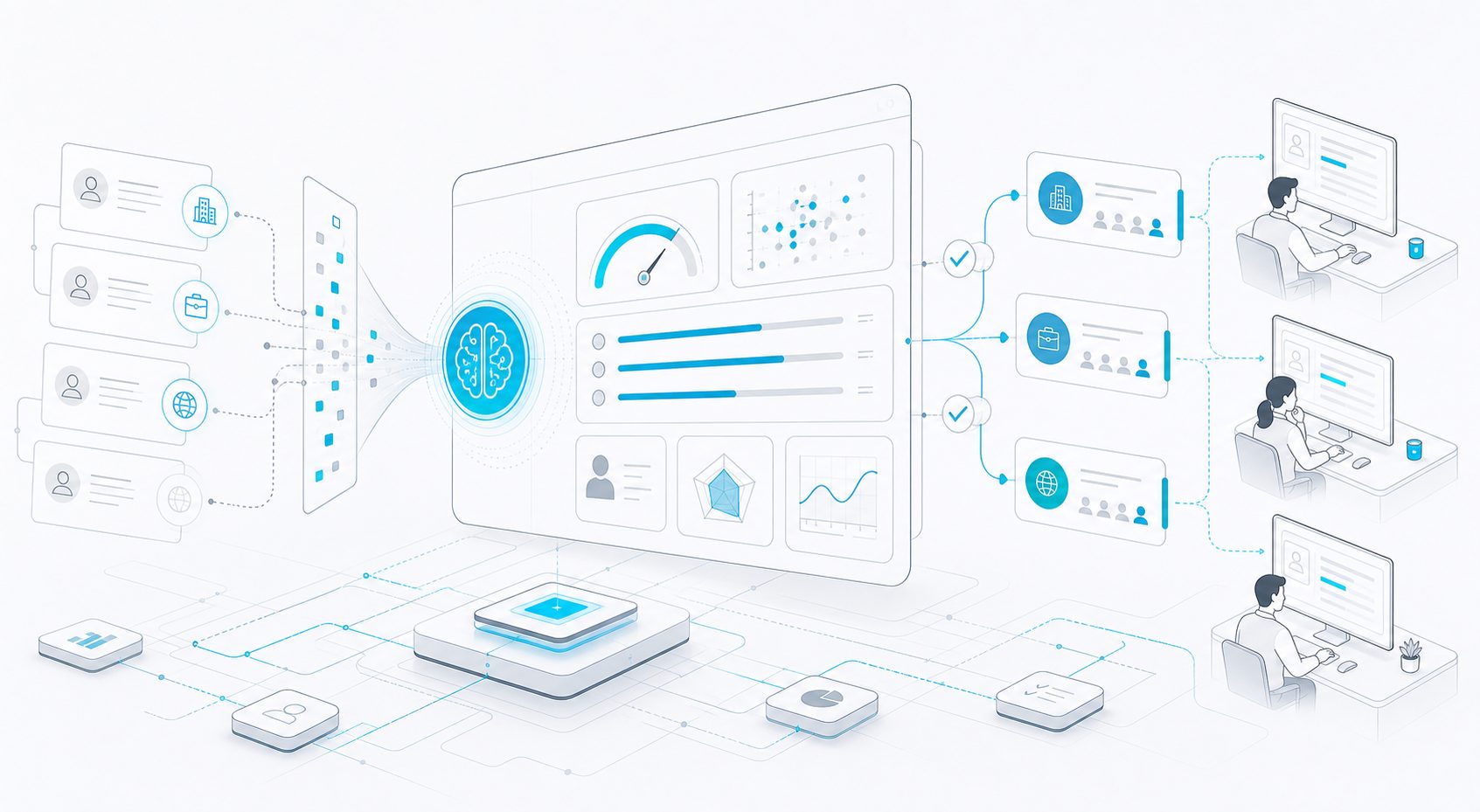
AI lead qualification automates the first layer of sales judgment: fit, intent, urgency, authority, and next-best action. In practice, it turns raw inbound signals into a routed outcome such as “book now,” “send to SDR,” “nurture,” “disqualify,” or “manual review.”
A useful system usually combines four capabilities:
- Capture: forms, chat, email replies, demo requests, event scans, or website activity.
- Enrichment: company size, industry, region, tech stack, funding, role, or account ownership.
- Conversation: questions that reveal pain, timeline, use case, and buying process.
- Decisioning: scoring, routing, CRM updates, calendar handoff, or nurture enrollment.
This is where many teams misbuy. They compare AI tools by feature lists, when the better question is: which qualification decision should the tool be trusted to make without a rep? A scoring-only platform, an AI SDR, and a website chat agent solve different jobs.
For a broader view of autonomous sales workflows, see toppp.ai’s guide to AI sales agents and what SaaS buyers should compare before buying.
Why B2B SaaS teams are replacing manual first-pass screening
Manual qualification breaks down when speed, consistency, and context all matter at once. A rep can make a nuanced call, but only if the lead is seen quickly, the CRM is complete, and the buyer’s question is not lost between systems.
The speed problem is well documented. The classic Lead Response Management study associated with MIT and InsideSales.com found that the odds of qualifying a lead were far higher when outreach happened within five minutes than after a longer delay; the underlying report is commonly cited for a 21x qualification difference between five and thirty minutes. The exact multiplier should not be treated as universal, but the operating lesson is durable: fresh intent decays quickly.
Buyer behavior has also changed. Gartner reported in June 2025 that 61% of B2B buyers preferred an overall rep-free buying experience, while 73% avoided suppliers that sent irrelevant outreach, based on its survey of 632 B2B buyers conducted in August-September 2024 (Gartner press release).
That creates a paradox: buyers want less irrelevant seller contact, but they still need contextual help when evaluating fit. AI for B2B lead qualification works best when it resolves that paradox: fast, useful screening before a human seller engages.
The Qualification Evidence Map: a better way to evaluate tools
The fastest way to choose a system is to map each qualification decision to the evidence needed to make it safely. This prevents a common failure: letting an AI agent decide outcomes from weak signals because the workflow was never designed.
Use this four-layer Qualification Evidence Map before comparing vendors:
| Qualification decision | Minimum evidence | Automation risk | Best AI action |
|---|---|---|---|
| Is this a real business inquiry? | Work email, company domain, message quality, spam signals | Low | Validate and create CRM record |
| Is this account in ICP? | Industry, employee count, region, product fit, current stack | Medium | Score and route by rules |
| Is there active buying intent? | Pain, urgency, project trigger, stakeholder role, page behavior | Medium-high | Ask follow-up questions |
| Should sales take a meeting now? | Fit, pain, timeline, authority, use case clarity, calendar match | High | Recommend, book, or request human review |
The point is to reserve human attention for decisions where judgment changes the outcome.
For teams designing routing logic, toppp.ai’s B2B sales qualification automation framework goes deeper into the rules, handoffs, and CRM data contracts that keep automation from becoming a black box.
What features matter most in an AI qualification tool?
The best features are the ones that improve a decision. For SaaS teams, the highest-value capabilities usually sit between the buyer conversation and the CRM handoff.
Prioritize these capabilities:
- Configurable ICP rules: The tool should understand your segment, not just assign a generic “hot lead” label.
- Conversational question handling: It should ask different follow-ups for a CFO, developer, founder, or operations lead.
- CRM-native evidence logging: Sales should see why a lead was qualified, not only the final score.
- Routing by territory and motion: Enterprise, self-serve, partner, and expansion leads should not follow one path.
- Human approval thresholds: The tool should know when to pause before booking or disqualifying.
- Knowledge governance: Messaging, qualification criteria, and objection handling should stay aligned with approved sales knowledge.
Avoid tools that only say “AI-powered lead scoring” without showing the inputs, confidence level, and routing logic. In B2B SaaS, a false positive wastes AE time, damages buyer trust, and pollutes pipeline reporting.

AI scoring vs. AI SDR vs. autonomous sales agent
AI scoring ranks leads. An AI SDR engages leads. An autonomous sales agent can coordinate multi-step qualification, follow-up, routing, and scheduling across systems. Buyers should choose based on the sales motion, not the most advanced label.
| Category | Best for | Limitation |
|---|---|---|
| AI lead scoring | High-volume inbound where data is already rich | Often misses context hidden in conversation |
| Conversational chatbot | Website visitors and demo-request triage | Can fail if it cannot access account rules or CRM ownership |
| AI SDR | Email, chat, SMS, and meeting booking | Needs strict guardrails for claims, pricing, and disqualification |
| Autonomous sales agent | Multi-step inbound qualification and routing | Requires stronger governance, testing, and workflow design |
For enterprise environments, governance becomes the buying criterion. If an AI agent can update CRM fields, book meetings, or send follow-up emails, the buyer should evaluate audit trails, permissions, escalation rules, and knowledge controls. The toppp.ai guide to enterprise AI sales agent evaluation covers those requirements in more detail.
A practical pilot plan for SaaS buyers
A good pilot should prove whether AI improves routing quality without hiding mistakes. Run it on the same sample of leads your human team would normally screen, then compare outcomes side by side.
Use this 14-day pilot design:
- Select 100-300 recent inbound leads across demo requests, contact forms, chat, and content conversions.
- Define the human baseline: current response time, accepted meetings, no-shows, disqualification reasons, and CRM completeness.
- Create a qualification rubric with required fields: ICP fit, persona, use case, urgency, authority, buying stage, and next action.
- Run the AI in shadow mode for the first week. Let it classify and recommend, but do not allow automatic booking or disqualification yet.
- Compare decisions against sales manager review. Track agreement rate, false positives, false negatives, and missing evidence.
- Turn on limited automation only for low-risk actions: enrichment, acknowledgments, routing suggestions, and meeting booking for high-confidence inbound leads.
- Review pipeline quality after 30 days, not just meetings booked. Bad automation often looks good until opportunity conversion is checked.
A useful acceptance target is not “100% accuracy.” For most SaaS teams, a stronger target is: reduce manual first-pass review by 40-60% while keeping false-positive meetings below an agreed threshold. That threshold depends on ACV, AE capacity, and the cost of a wasted sales cycle.
The hidden buying question: what should AI never decide alone?
AI should not independently make decisions that require commercial judgment, legal interpretation, or sensitive exception handling. It can recommend, summarize, and route, but final control should stay with a human when risk is high.
Keep human approval for:
- Enterprise pricing exceptions
- Security or compliance commitments
- Contractual promises
- Competitive claims
- Strategic account disqualification
- Partner conflict resolution
- Unusual buyer requests outside the playbook
This is where many AI qualification projects fail. They start by asking, “Can the agent book more meetings?” A better framing: “Which decisions are safe to automate, and which need a human checkpoint?”
For teams comparing tools by ROI rather than novelty, toppp.ai’s AI sales agents with the highest ROI evaluation framework can help connect automation scope to payback.
How to calculate ROI without fooling yourself
ROI for sales qualification automation should be measured in qualified pipeline quality, not just rep hours saved. The simplest model combines time savings, speed-to-lead lift, meeting quality, and downstream conversion.
Use this formula:
Monthly ROI = incremental qualified pipeline value + recovered rep hours value – software and implementation cost
Track these metrics before and after rollout:
- Median first-response time
- Percentage of leads enriched before rep review
- Percentage routed with complete required fields
- Meeting acceptance rate
- No-show rate
- Opportunity creation rate
- Stage-two conversion rate
- Rep time spent on unqualified inquiries
- Disqualification accuracy after manager review
A warning: if meetings booked rise but opportunity conversion falls, the system is probably over-qualifying weak leads. AI for B2B lead qualification should improve decision quality, not simply increase calendar volume.
Common mistakes when buying AI for B2B lead qualification
Most failed deployments are caused by unclear qualification rules, poor CRM hygiene, or too much autonomy too soon. The tool gets blamed, but the real issue is usually decision design.
Avoid these mistakes:
- Buying before defining “qualified.” MQL, SQL, PQL, and sales-accepted lead should have written criteria.
- Using one score for every segment. SMB self-serve, mid-market, and enterprise leads need different thresholds.
- Letting AI disqualify strategic accounts. Strategic fit sometimes beats form completeness.
- Ignoring source quality. Paid search, partner referrals, review-site traffic, and outbound replies carry different intent.
- Failing to log evidence. A score without reasoning is hard for sales to trust.
- Optimizing for demo bookings only. The real test is pipeline progression.
A practical rule: automate the action only when the evidence is strong enough to defend the decision in a pipeline review.
Recommended buying checklist
A strong AI qualification platform should help your team answer five questions quickly: who is the buyer, what do they need, are they a fit, what should happen next, and why?
Use this checklist during vendor evaluation:
- Can qualification criteria be customized by segment, product, and region?
- Does the system ask adaptive follow-up questions?
- Can it separate fit, intent, urgency, and authority instead of blending them into one vague score?
- Does it integrate with your CRM, calendar, enrichment, chat, and marketing automation stack?
- Does it show the evidence behind each routing decision?
- Can managers review, override, and retrain rules?
- Are there permission controls for messages, claims, and actions?
- Can the tool run in shadow mode before automation goes live?
- Does reporting connect qualification decisions to opportunity outcomes?
For SaaS buyers who need a broader vendor comparison, toppp.ai’s Best AI Sales Agents in 2026 explains how different AI sales platforms fit different motions.
Frequently asked questions
What is AI for B2B lead qualification?
AI for B2B lead qualification is software that evaluates business leads using firmographic data, buyer behavior, conversation responses, and CRM rules. It helps sales teams decide which leads deserve immediate follow-up, nurture, routing, or human review.
Is AI lead scoring the same as lead qualification?
No. AI lead scoring ranks the likelihood that a lead is valuable. Lead qualification is broader: it gathers missing context, validates fit, identifies intent, determines urgency, and recommends the next action.
Should AI automatically book meetings with sales?
Yes, but only for high-confidence leads that meet clear criteria. Lower-confidence leads should be routed to an SDR, sent to nurture, or flagged for review. Automatic booking without evidence controls can create low-quality meetings.
What data does an AI qualification tool need?
It usually needs CRM records, form fields, company enrichment, website behavior, campaign source, conversation history, qualification rules, routing ownership, and calendar availability. The more structured the data contract, the safer the automation.
How long should a pilot take?
A focused pilot can run for 14 days, followed by a 30-day pipeline-quality review. The pilot should compare AI recommendations against human review before allowing full automation.
Final recommendation
AI for B2B lead qualification is worth buying when your team has enough inbound volume, slow or inconsistent first response, messy routing, or too many low-fit meetings. It does not replace defining your ICP, qualification rules, and CRM data standards.
The best system is the one that makes the first sales decision faster, more explainable, and easier for humans to trust.
Keep reading

Red Flags in SaaS Vendor Agreements: A Buyer’s Review Checklist
Spot red flags in SaaS vendor agreements before signing, from renewal traps and price increases to data rights, liability gaps, and exit costs.

SaaS MSA Negotiation Checklist for Buyers
Use this SaaS MSA negotiation checklist for buyers to review pricing, data, SLAs, liability, indemnity, renewal, and exit terms before signing.

SaaS vendor IP indemnification scope checklist: Buyer review guide
Use this SaaS vendor IP indemnification scope checklist to test covered claims, exclusions, defense rights, remedies, caps, and third-party risk before signing.