
AI Agents for Sales: A SaaS Buyer Framework
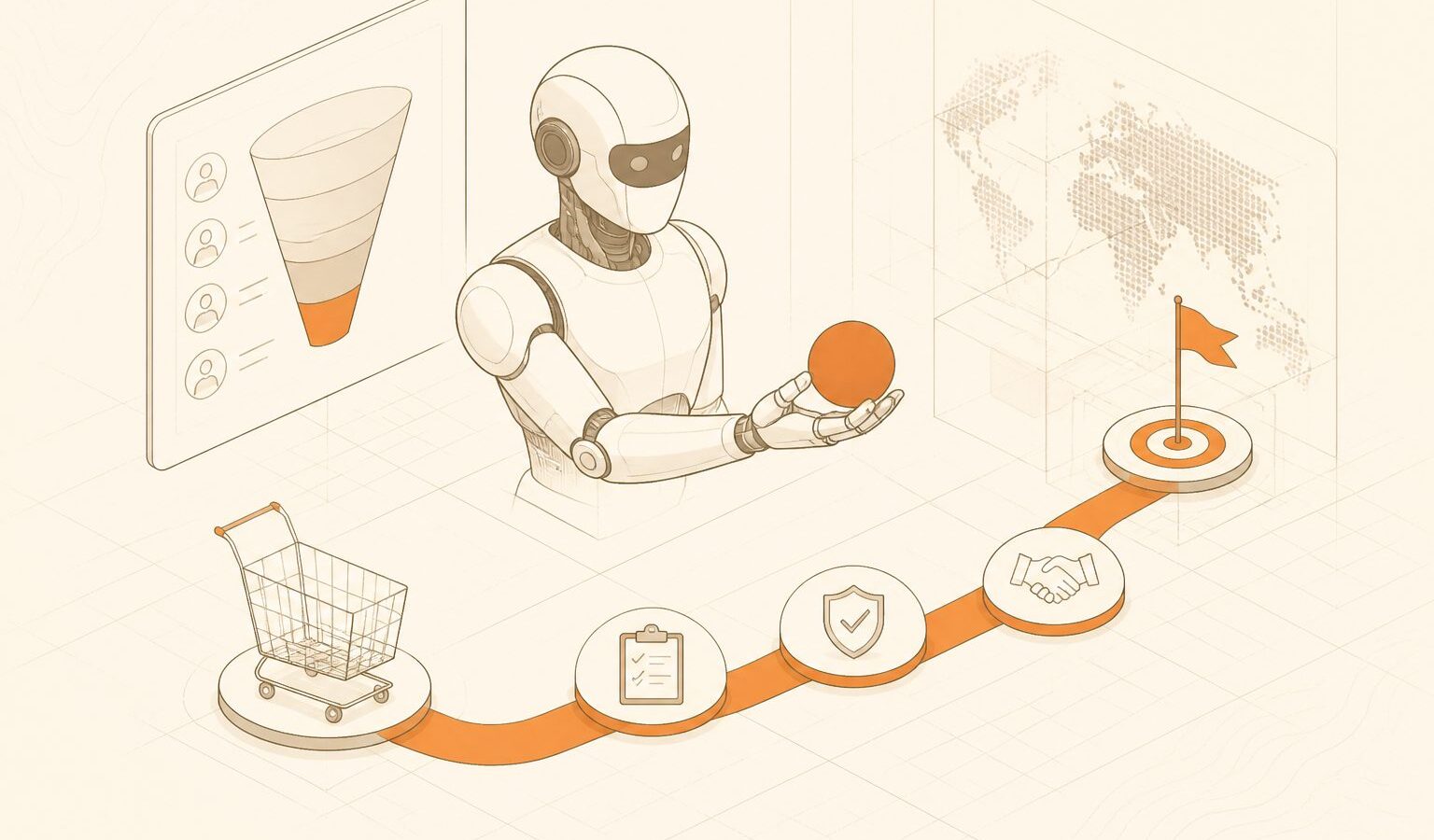
AI agents for sales are software systems that can interpret buyer signals, take defined sales actions, and update revenue systems with limited human input. For SaaS buyers, the central question is which sales job an agent should own without hurting trust, data quality, or pipeline control.
Most teams should start with one bounded workflow: inbound qualification, speed-to-lead follow-up, CRM hygiene, meeting scheduling, or account research. Full-cycle autonomous selling is possible in narrow motions, but it is rarely the safest first purchase for a B2B SaaS team.

What are AI agents for sales?
AI agents for sales are autonomous or semi-autonomous systems that complete sales tasks across multiple steps, such as researching a prospect, asking qualification questions, routing a lead, booking a meeting, and writing notes back to the CRM.
They differ from basic chatbots because they use context, tools, decision rules, and workflow permissions. A chatbot may answer a question. An AI sales agent can decide whether the visitor fits your ICP, request missing information, trigger a calendar handoff, and log the interaction.
For SaaS buyers, the most common agent categories are:
- Inbound qualification agents for website visitors and demo requests.
- AI SDR agents for prospect research, outreach assistance, and follow-up.
- Sales admin agents for CRM updates, call summaries, and task creation.
- Conversation agents for guided buyer chats, objection handling, and meeting booking.
- Revenue orchestration agents that coordinate routing, enrichment, alerts, and next actions.
Gartner has predicted that B2B sales organizations using embedded generative AI sales technologies will reduce time spent on prospecting and meeting preparation by over 50% by 2026, according to its GenAI sales technologies forecast. That upside is meaningful, but only if the agent is mapped to a specific revenue bottleneck.
Where do AI sales agents create the fastest SaaS ROI?
The fastest ROI usually comes from workflows where speed, consistency, and structured data matter more than human persuasion. In SaaS, that means inbound response, lead qualification, enrichment, routing, and post-conversation follow-up.
A practical way to choose the first use case is to score each sales workflow across three dimensions:
| Workflow | Agent fit | Human risk | Best first metric |
|---|---|---|---|
| Website demo qualification | High | Medium | Visitor-to-meeting rate |
| Speed-to-lead follow-up | High | Low | Median first response time |
| CRM note capture | High | Low | % meetings with usable notes |
| Outbound prospecting | Medium | Medium | Positive reply rate |
| Pricing negotiation | Low | High | Human-assisted only |
| Enterprise procurement | Low | High | Escalation quality |
Agents perform best when the task has a defined playbook, available data, and a measurable next step. They struggle when the buyer asks for strategic judgment, complex discounting, legal interpretation, or nuanced competitor positioning.
McKinsey’s research on human-agent work redesign makes a similar point: value comes when companies redesign workflows so people spend less time on routine tasks and more time on customer-facing work. Its analysis of people-agent collaboration includes sales examples where agents support research, scheduling, coaching, and administration rather than replacing every seller action.
A SaaS buyer framework: Fit, control, evidence, expansion
The strongest buying process evaluates AI agents for sales across four gates: workflow fit, control design, evidence quality, and expansion path. Skipping any gate often leads to a tool that demos well but fails in production.
1. Workflow fit: define the agent’s job in one sentence
A sales agent should have a job description before it has a vendor shortlist. “Help sales” is too vague. “Qualify inbound demo requests using firmographic, product-fit, and urgency signals, then route qualified accounts to the right AE” is specific enough to test.
Use this one-sentence format:
The agent will [action] for [buyer segment] using [data sources] and will hand off when [risk condition appears].
For a deeper comparison of agent categories, see toppp.ai’s guide to what SaaS buyers should compare before buying AI sales agents.
2. Control design: decide what the agent can do alone
Control is the difference between useful automation and revenue risk. Buyers should ask what actions the agent can take without approval, what requires human review, and what is never allowed.
A simple permission model works well:
- Observe: read CRM records, website behavior, chat history, and enrichment data.
- Recommend: suggest qualification status, next best action, or routing.
- Act with guardrails: send approved messages, book meetings, update fields.
- Escalate: hand off pricing, legal, security, competitor, or enterprise buying questions.
- Block: prevent action when data is missing, confidence is low, or compliance rules apply.
This matters because autonomous sales software touches brand voice, buyer trust, and CRM truth. A bad meeting booked by an agent is not just a bad conversion; it consumes AE time and weakens confidence in the system.
3. Evidence quality: test outcomes, not feature claims
A polished demo is not proof. SaaS buyers should test AI sales agents against a sample of real conversations, forms, accounts, and edge cases before committing.
A useful pilot includes:
- 50-100 historical leads across qualified, unqualified, ambiguous, and spam cases.
- 10-20 live conversations monitored by sales or RevOps.
- A baseline period from the existing process.
- Clear pass/fail rules for routing accuracy, meeting quality, CRM updates, and escalation.
- Rep feedback on whether the agent saved time or created cleanup work.
Measure both conversion and operational quality. A tool that increases meeting volume but lowers meeting quality may make dashboards look better while hurting pipeline.
4. Expansion path: avoid buying a dead-end agent
The best first agent should create reusable assets: qualification logic, routing rules, buyer objections, knowledge base answers, and CRM hygiene patterns. Those assets can later power automated sales development systems, conversation intelligence, and 24/7 sales coverage.
Before buying, ask whether the vendor can support adjacent workflows. For example, a team that starts with inbound qualification may later need overnight follow-up, sales playbook automation, or account-based routing. toppp.ai’s guide to automated sales development systems is useful when comparing that broader path.
The hidden cost model most comparison pages miss
The purchase price is only one part of AI sales agent ROI. The bigger cost is the operating model around the agent: data cleanup, playbook writing, CRM field governance, escalation review, and ongoing quality assurance.
Use this cost model before signing:
| Cost area | What to estimate | Why it matters |
|---|---|---|
| Data readiness | Duplicate records, missing fields, stale enrichment | Bad data creates bad actions |
| Playbook setup | ICP rules, disqualification logic, objection responses | Agents need bounded judgment |
| Integration work | CRM, calendar, chat, enrichment, routing, email | Workflow gaps create manual cleanup |
| QA time | Weekly conversation review and false-positive checks | Trust decays after repeated errors |
| Change management | Rep training and manager adoption | Sellers ignore tools they do not trust |
A simple ROI formula is:
Monthly value = hours saved + incremental qualified meetings + faster response gains – software cost – operating cost.
For example, if an agent saves 40 SDR hours per month, improves qualified meeting capture from high-intent visitors, and reduces manual CRM cleanup, it may justify itself quickly. But if RevOps spends every week fixing routing errors, the real ROI collapses.
For SaaS buyers focused specifically on return modeling, toppp.ai’s AI sales agents with the highest ROI evaluation framework expands this calculation.
Red flags when comparing vendors
A strong AI sales agent vendor can explain what the system should not do. Be cautious when a vendor claims full autonomy across prospecting, qualification, objection handling, pricing, and closing without clear limits.
Watch for these red flags:
- No documented handoff rules for pricing, legal, security, or enterprise questions.
- No way to audit why the agent qualified or disqualified a lead.
- Weak CRM writeback controls.
- No sandbox or historical lead test.
- Overreliance on generic prompts instead of structured playbooks.
- No reporting on false positives, false negatives, or escalation quality.
- Claims of replacing entire sales teams without workflow-specific evidence.
The best vendors are usually more precise. They can say, “This agent is excellent at inbound qualification for defined SaaS offers, but enterprise procurement and custom pricing should go to a human.”
How to pilot AI agents for sales in 30 days
A 30-day pilot should prove whether the agent improves one measurable workflow without damaging buyer experience or CRM quality. Keep the scope narrow and the evaluation honest.
Week 1: Define the workflow. Choose one job, such as demo-request qualification or speed-to-lead follow-up. Document ICP rules, disqualification reasons, required CRM fields, and escalation triggers.
Week 2: Test historical cases. Run past leads through the agent. Compare its qualification decisions against human outcomes. Identify where it over-qualifies, under-qualifies, or asks weak questions.
Week 3: Launch with supervision. Use the agent on a limited live segment. Monitor every conversation or action. Require human approval for uncertain cases.
Week 4: Score business impact. Review meeting quality, response time, routing accuracy, CRM completeness, and seller feedback. Do not expand unless the agent improves both efficiency and trust.
This pilot structure also helps buyers compare vendors fairly. Each tool faces the same data, same edge cases, and same success criteria.
Frequently asked questions
Are AI agents for sales the same as AI SDRs?
No. An AI SDR is one type of sales agent focused on sales development tasks such as research, outreach, qualification, and meeting booking. AI agents for sales can also support inbound chat, CRM administration, sales coaching, routing, and revenue operations.
Can an AI sales agent replace a human sales rep?
In most B2B SaaS motions, it should not replace the full rep role. It can replace or reduce repetitive tasks, but humans should handle strategic discovery, complex objections, procurement, pricing judgment, and relationship-building.
What data does a sales agent need?
At minimum, it needs CRM records, lead source, firmographic data, product or pricing knowledge, qualification criteria, calendar access, and clear routing rules. More advanced deployments use website intent, product usage, enrichment, call notes, and account history.
What is the safest first use case?
The safest first use case is usually inbound qualification or speed-to-lead follow-up. These workflows are measurable, time-sensitive, and easier to constrain than full outbound automation or negotiation.
How should SaaS buyers compare tools?
Compare tools by workflow fit, CRM integration, guardrails, auditability, pilot results, and expansion path. Feature lists matter less than whether the agent can perform the exact sales job you need with measurable accuracy.
Bottom line: buy the workflow, not the buzzword
AI agents for sales can create real SaaS value when they own a bounded, measurable workflow. The best first purchase is rarely the most autonomous system. It is the agent that improves speed, qualification quality, CRM hygiene, and seller focus without creating hidden cleanup work.
For teams comparing options by sales motion, toppp.ai’s guide to the best AI sales agents in 2026 can help narrow the shortlist after the internal workflow is defined.
Keep reading

Red Flags in SaaS Vendor Agreements: A Buyer’s Review Checklist
Spot red flags in SaaS vendor agreements before signing, from renewal traps and price increases to data rights, liability gaps, and exit costs.

SaaS MSA Negotiation Checklist for Buyers
Use this SaaS MSA negotiation checklist for buyers to review pricing, data, SLAs, liability, indemnity, renewal, and exit terms before signing.

SaaS vendor IP indemnification scope checklist: Buyer review guide
Use this SaaS vendor IP indemnification scope checklist to test covered claims, exclusions, defense rights, remedies, caps, and third-party risk before signing.