
Custom AI Sales Agent vs Building From Scratch: A SaaS Buyer Decision Guide
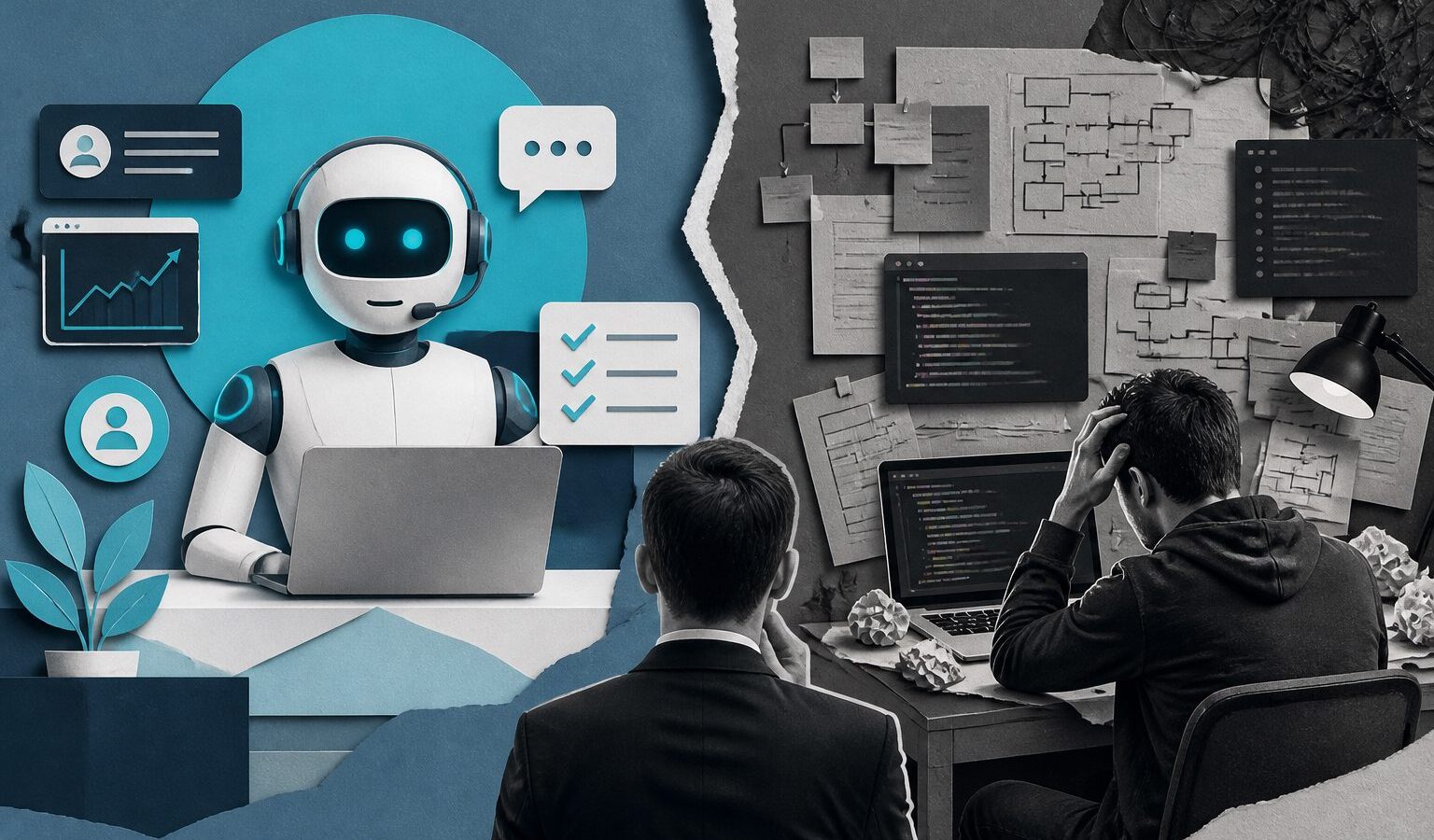
Most SaaS teams frame custom AI sales agent vs building from scratch as a software choice. Price both options honestly and it turns into a staffing question: how much engineering, RevOps, legal review, and sales-leadership attention you are willing to lock up for the next two years. The option that survives that math is usually a configurable agent whose data, workflows, guardrails, and reporting you actually own.
What follows: cost, time-to-value, control, compliance exposure, maintenance load, and a layer-by-layer way to split the decision before any budget moves.

What is a custom AI sales agent?
A custom AI sales agent is an AI-powered system configured around your sales motion, ICP, qualification rules, routing logic, CRM fields, messaging guidelines, and handoff process. It may run on a vendor platform, an agent-builder framework, or your own infrastructure.
For SaaS teams, “custom” should not automatically mean “built from zero.” An agent can be deeply custom and still sit on an existing platform, as long as the workflows, knowledge base, scoring rules, integrations, and governance are tailored to your business.
That distinction matters more than it sounds. Nobody in a pipeline review asks whether the agent was handmade. They ask whether it answered the prospect in two minutes, noticed the account was already in an open deal cycle, wrote the context back to the CRM, and handed off to a human before it started guessing at pricing.
For the wider category view, what SaaS buyers should compare in AI sales agents covers the feature-level checklist this guide assumes you have already run.
What does building an AI sales agent from scratch involve?
Building from scratch means your team owns the architecture, code, prompts, data pipelines, orchestration, integrations, evaluations, monitoring, security model, and everything that breaks afterwards. Budget it like a product line, with a roadmap and an on-call rotation.
A demo needs a prompt. A production AI sales agent needs all of this:
- CRM and marketing automation integrations
- Sales knowledge ingestion and retrieval
- Conversation memory and context handling
- Qualification and routing logic
- Human escalation rules
- Testing and evaluation workflows
- Audit logs and permissions
- Compliance controls for email, chat, SMS, or voice
- Monitoring for hallucinations, latency, and failed actions
- Ongoing prompt, model, and workflow updates
Your engineers can probably build it. That was never the hard part. The open question is whether keeping it healthy for two years beats shipping the onboarding flow, the usage-based billing work, or the data warehouse half the company is waiting on.
The shortest answer: when should SaaS teams buy, customize, or build?
Buy when the workflow is common, customize when the workflow is revenue-specific, and build only when the agent itself is strategic IP. Most SaaS sales motions land in the middle: heavy configuration, no new codebase.
The rough split:
| Decision path | Best fit | Warning sign |
|---|---|---|
| Buy off-the-shelf | Simple lead response, meeting booking, FAQ handling | The tool cannot adapt to your routing or ICP |
| Customize a platform | SaaS qualification, demo routing, account research, follow-up | Vendor hides data access or workflow logic |
| Build from scratch | Proprietary sales intelligence, unique marketplace logic, regulated internal workflows | Engineering becomes the support desk for sales automation |
For most B2B SaaS buyers weighing custom AI sales agent vs building from scratch, the path that holds up is a configurable platform where the data exports cleanly, the rules are readable by someone outside engineering, and the ROI can be measured against a control group.
Cost comparison: the TCO model most teams forget
The prototype is the cheap part. The bill starts after the demo works and someone has to carry the thing through a model deprecation, a CRM field rename, and a repackaging of your pricing tiers.
Here is a TCO frame for a mid-market SaaS team looking at a 12-month AI sales agent rollout. Put your own numbers against each line.
| Cost category | Build from scratch | Custom platform configuration |
|---|---|---|
| Initial workflow design | High | Medium |
| Engineering implementation | Very high | Low to medium |
| CRM and data integrations | High | Medium |
| Evaluation harness | High | Medium |
| Security and access controls | High | Medium |
| Sales playbook maintenance | Medium | Medium |
| Model and API changes | Ongoing internal burden | Shared with vendor |
| RevOps administration | Medium | Medium |
| Time to first reliable pilot | Often 3–6 months | Often weeks |
| Opportunity cost | High | Lower |
Opportunity cost is usually the largest line and the only one that never appears in the budget. Two engineers on agent infrastructure for a quarter is one quarter of retention, activation, or billing work that did not ship.
One test settles most of these arguments. The agent starts mis-routing leads at 5 p.m. on a Friday: who fixes it? If the answer is your best backend engineer, the budget line is fiction.
Control comparison: code ownership is not the same as business control
Control means the business can change how the agent behaves without breaking it. Source access helps only if you also own the data model, the evaluation process, the deployment workflow, and the documentation that lets a second person do the work.
This is where build-from-scratch plans get fragile. Full technical control counts for very little when one engineer is the only person who understands the orchestration and that engineer is on PTO. A vendor platform can end up giving the business faster control, because RevOps changes routing on a Tuesday afternoon without waiting for a release.
Before choosing, ask five control questions:
- Can RevOps edit qualification logic directly, or does every change wait for a code release?
- Can a sales leader see why the agent scored or routed a specific account the way it did?
- Can admins restrict which records and fields the agent is allowed to read?
- Can the team export conversations, outcomes, and scoring data in a usable format?
- Can the company switch vendors without losing the operating history behind those decisions?
Risk comparison: compliance, trust, and customer experience
AI sales agents touch prospects, customer data, and sometimes regulated communication channels. Compliance belongs in the evaluation, next to pricing.
U.S. teams running AI voice or automated outbound have a narrower lane than they usually assume. In 2024 the FCC ruled that calls using AI-generated voices count as “artificial” under the Telephone Consumer Protection Act, set out in the FCC’s AI-generated voice robocall ruling announcement. The FTC covered deceptive AI-enabled telemarketing in its Telemarketing Sales Rule update.
B2B motions are not exempt in practice. Keep consent records, suppression lists, plain identity disclosure, reviewable logs, and a human escalation path. Keep them somewhere your legal reviewer can find in an afternoon.
For governance beyond outreach channels, NIST’s AI Risk Management Framework gives a workable structure for mapping, measuring, managing, and governing AI-related risk.
The overlooked factor: sales knowledge decay
Most comparisons of custom AI sales agent vs building from scratch stay on engineering ground. The expensive failure usually sits somewhere else: the knowledge inside the agent goes stale.
SaaS sales knowledge changes constantly:
- ICP definitions shift after pricing or packaging changes.
- Competitor battlecards age quickly.
- Product limitations change after releases.
- Qualification rules evolve as pipeline quality changes.
- Top rep talk tracks rarely make it into official documentation.
Built-from-scratch systems tend to launch with a clean knowledge base. Six months later the agent is still quoting the old packaging tiers, because updating it was in nobody’s job description. Whichever path you take, the update route has to sit inside the revenue workflow: call learnings, objection handling, CRM notes, release notes, and routing exceptions all need a controlled way in.
Give knowledge operations its own line in the scorecard. Sales knowledge capture automation goes into how to keep revenue knowledge from living only in reps’ heads.
A practical decision framework: the 5-layer AI sales agent model
Decide this one layer at a time. “Should we build the whole thing?” has no good answer at any company. “Which layer actually differentiates us?” usually has an obvious one.
| Layer | What it includes | Recommended default |
|---|---|---|
| Foundation | LLM access, hosting, observability, security basics | Buy or use managed infrastructure |
| Data connections | CRM, product usage, enrichment, marketing data | Configure, rarely build fully |
| Sales logic | ICP, qualification, routing, objection handling | Customize deeply |
| Experience layer | Chat, email, voice, meeting booking, handoff | Buy and customize |
| Proprietary intelligence | Unique scoring, intent signals, account strategy | Build selectively |
Split this way, the argument stops being about the whole system and starts being about the one layer worth arguing over.
Almost nobody should build their own meeting-booking infrastructure. Plenty of companies should own their account-priority score, because product usage, expansion signals, and sales-cycle history are theirs and nobody else’s.
Buy the plumbing, configure the workflow, build the part that compounds.

How to run a 30-day pilot before committing
A 30-day pilot has to answer one question: did this move a sales number the current process was not already moving? Technical feasibility gets settled in week one and stops being interesting.
Use this structure:
- Pick one sales motion. Start with inbound qualification, demo routing, trial follow-up, or reactivation. Avoid automating every channel at once.
- Define the baseline. Measure current speed-to-lead, qualification rate, meeting conversion, no-show rate, and rep time spent.
- Create a test set. Use 50–100 anonymized historical conversations or lead records to check accuracy before anything goes live.
- Set pass/fail criteria. Examples: 90% correct routing on test leads, under two minutes median response time, zero unsupported claims in reviewed conversations.
- Run human-in-the-loop. Let the agent draft, qualify, or recommend while humans approve sensitive actions.
- Review failure modes weekly. Tag misses by cause: missing knowledge, bad integration data, unclear prompt, weak escalation, or invalid prospect input.
- Calculate operational ROI. Count rep hours returned, response time, routing accuracy, and leads that stopped falling out of the funnel. Software cost is the smallest term in that sum.
To connect agent performance to pipeline economics, AI sales agents with the highest ROI lays out a fuller measurement frame.
What to ask vendors if you choose a custom AI sales agent
Demos are rehearsed. The questions worth asking are about month seven: adaptability, governance, and who carries the pager.
Ask:
- How does the agent ingest and update sales knowledge?
- Can we inspect the logic behind qualification and routing?
- What CRM objects and fields can the agent read and write?
- How are hallucinations detected and reviewed?
- What happens when the model provider changes behavior?
- Can we export transcripts, scores, and outcomes?
- How are permissions, audit logs, and role-based access handled?
- Which workflows require vendor support to change?
- What is the rollback process after a bad configuration?
- How is performance measured against a control group?
A good provider welcomes these questions. If every answer routes through a services engagement, the “platform” is behaving more like outsourced development with a subscription attached.
For a tool-by-tool map against different sales motions, Best AI Sales Agents in 2026 is the better starting point.
When building from scratch is actually the right choice
Building from scratch earns its keep when the agent depends on proprietary logic competitors cannot easily copy, and that logic moves your company’s advantage directly.
Good reasons to build include:
- Your sales motion depends on unique product telemetry.
- The agent must reason over proprietary marketplace or usage data.
- You need deep integration with internal systems that expose no usable API.
- The agent will become part of your product, and your customers will see it.
- You have dedicated long-term owners for reliability, evaluation, and governance.
Weak reasons to build include:
- “We do not want another SaaS subscription.”
- “Our workflow is unique” without proving which layer is unique.
- “The prototype worked.”
- “We want full control” without a maintenance plan.
- “Our engineers can build it quickly.”
A prototype proves possibility. A production sales agent has to prove reliability, safety, adaptability, and measurable revenue impact.
When a custom platform is the better answer
A custom platform usually wins when the sales workflow matters and the infrastructure underneath it creates no differentiation at all. That covers a long list of SaaS use cases: inbound qualification, lead follow-up, product-led sales alerts, meeting booking, and routing.
The strongest platform candidates offer:
- Playbooks a RevOps admin can change without a release
- CRM-native workflows, so the record of truth stays in one place
- Handoff rules that name the trigger and the human
- A view where a sales manager can read yesterday’s conversations
- Knowledge-base governance with an owner and a review date
- Conversation review that surfaces unsupported claims
- Outcome reporting tied to pipeline, not activity counts
- A safe way to test a change on a slice of leads first
Qualification-heavy teams feel this most. When the whole problem is getting the right account to the right rep before the buying window closes, workflow accuracy is what you are actually buying. B2B sales qualification automation covers that routing problem in more detail.
Final recommendation for SaaS buyers
The workable answer to custom AI sales agent vs building from scratch is usually to customize before you code. Configure the foundation, own the revenue logic, and build only the proprietary layer that gives your SaaS company a durable advantage.
A simple decision rule works well:
- If the workflow is generic, buy.
- If the workflow is sales-specific, customize.
- If the workflow is strategic IP, build that layer.
- If the risks are unclear, pilot with human review before scaling.
That keeps you clear of the two most expensive mistakes: locking your sales team inside a rigid black box, or turning your engineering team into a permanent AI sales infrastructure department.
Frequently asked questions
Is a custom AI sales agent the same as building from scratch?
No. A custom AI sales agent can be configured on top of an existing platform. Building from scratch means your team owns the full technical stack, including orchestration, integrations, evaluation, monitoring, and maintenance.
Is building an AI sales agent cheaper in the long run?
Only if the agent creates proprietary value and your team can maintain it efficiently. For common SaaS sales workflows, maintenance, compliance, integrations, and opportunity cost usually make building more expensive than the first estimate.
What is the biggest risk of buying an AI sales agent platform?
Operational lock-in. Before signing, check whether you can export data, inspect workflows, adjust logic, review decisions, and keep the sales history if you change vendors.
What is the biggest risk of building from scratch?
The demo-to-production gap. A prototype may work on a handful of examples, while a production sales agent needs monitoring, permissions, fallback handling, evaluation, compliance controls, and continuous knowledge updates.
What should a SaaS team automate first?
Start with a narrow, measurable workflow such as inbound lead qualification, demo routing, trial follow-up, or low-risk account reactivation. Avoid launching autonomous outbound across every segment before quality and governance are proven.
Keep reading

SaaS Vendor Source Code Escrow Clause: Buyer Negotiation Guide
A SaaS vendor source code escrow clause should cover code, cloud deployment, data export, testing, and release triggers. Use this buyer checklist to negotiate continuity protection.

SaaS Contract Breach Cure Period Standard: Buyer Benchmarks and Clause Terms
Learn the SaaS contract breach cure period standard, including 5-, 10-, 15-, and 30-day benchmarks, carve-outs, notice rules, and buyer protections.
SaaS grandfathered pricing policy review: A buyer’s renewal checklist
SaaS grandfathered pricing policy review for buyers: identify hidden repricing triggers, test renewal language, and negotiate defensible price protection.